Applications
FMCG-Sim: An Indian Business Simulation for the MBA Core
Six rounds of FMCG competition built to replace an imported simulation with an Indian one.
A web-based business simulation for the MBA core at IIM Calcutta, written to replace Capsim with an Indian-context packaged-foods game. Teams run an umbrella brand across six rounds; the mechanics are built around an Indian market rather than translated into one.
Most Indian MBA programmes teach strategy through an imported simulation. The market it models is not the market the students will work in: the channels are wrong, the price points are wrong, and the consumer behaviour underneath is borrowed. FMCG-Sim is the attempt to build the Indian one.
The problem
Capsim and its peers do a lot well. They are also built around a sensor manufacturer selling through a single channel to a market that behaves like the United States in the 1990s. An Indian student running the simulation learns the mechanics of the game and then has to unlearn most of the market.
The specific gaps that matter for an Indian cohort:
- Channel. General trade, modern trade, e-commerce and quick commerce are four different businesses with different margins, different shelf logic and different working-capital consequences. A one-channel model cannot teach that.
- The perceptual map. A fixed two-dimensional map of performance against size is not how a packaged-foods brand is positioned.
- R&D certainty. Deterministic R&D teaches planning. It does not teach the thing that actually governs innovation portfolios, which is failure.
What it is
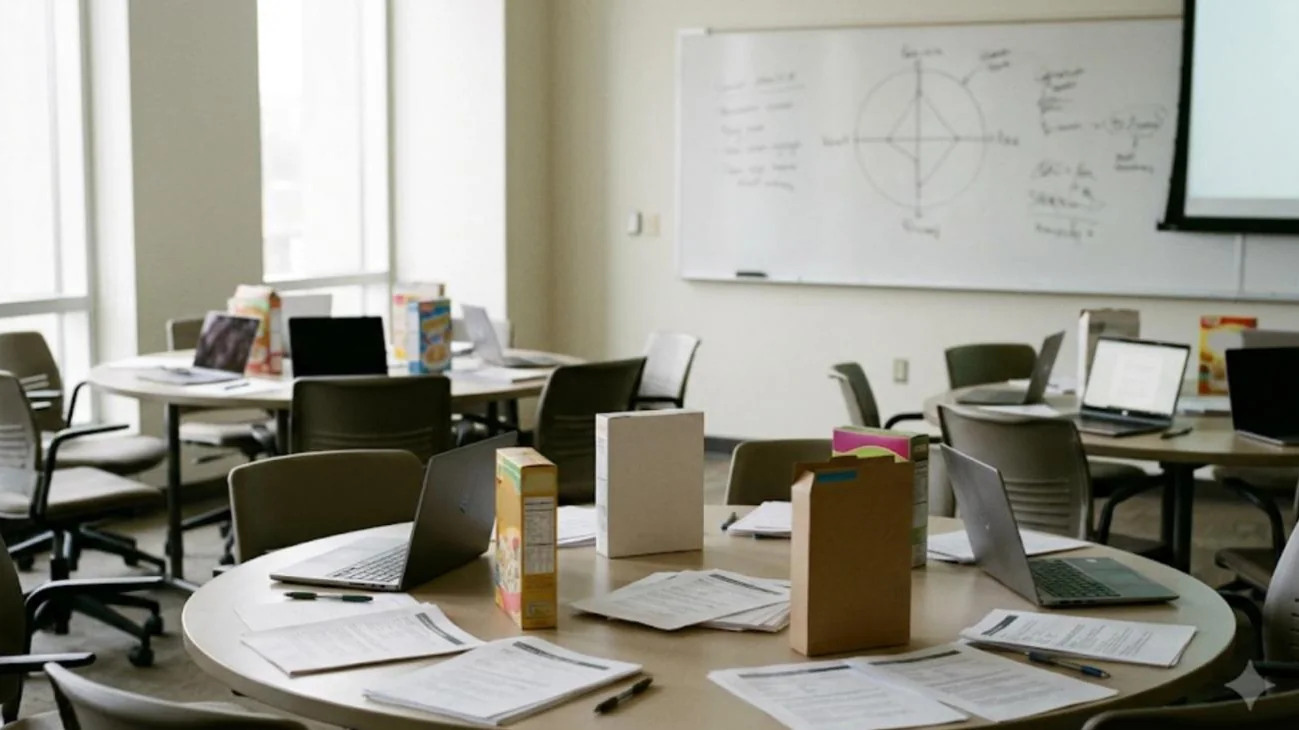
Six rounds plus a practice round, eight or more student teams, and one computer-controlled competitor called Generica so a weak cohort still faces a floor. Each team manages an umbrella brand with up to three products in a packaged-foods category, with breakfast cereals as the primary. Each round is one business year.
Teams decide across seven modules: R&D, Marketing, Operations, Finance, HR, TQM and ESG. The engine runs every team’s decisions through one market model and returns financial statements, market shares and a balanced scorecard.
Where it differs
The mechanics are deliberately not Capsim’s.
- A four-dimensional Brand DNA Wheel — Health, Taste, Premium-ness and Sustainability — replaces the two-dimensional map, with a simplified 2D view for the first rounds.
- Freshness and variety-seeking replace the age-of-product mechanic, and are grounded in the consumer behaviour literature rather than in a decay curve.
- R&D carries real failure probability across four innovation horizons. Portfolios have to be built to survive a loss.
- Channel strategy and marketing mix are decided separately, across the four Indian channels.
Where it stands
The project runs in four phases: spine documentation, documentation scaffold, application build, then tuning against a pilot cohort. It is in phase one, the spine: the architecture, the mechanics rulebook and the module specifications. Application code starts when the rulebook is settled, because a simulation whose mechanics move during the build teaches nothing twice.
The documentation is written to be read by a coding agent as well as by a person, which is the same discipline as the Forge family: the specification is the artefact, and the code follows it.